

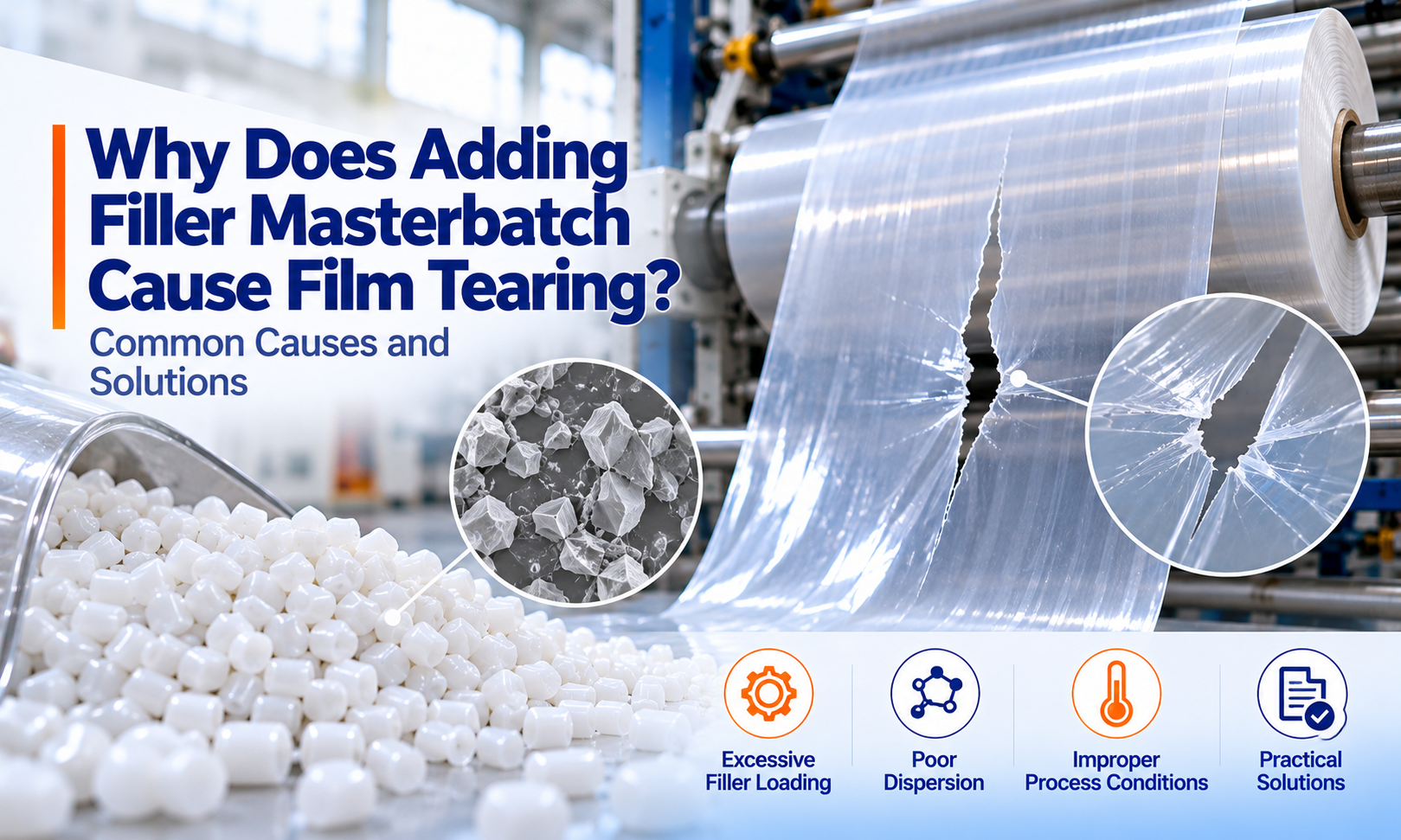
Why Does PE Film Tear After Adding Filler Masterbatch?
Film tearing after a filler masterbatch change may involve excessive loading, agglomerates, thin spots or shifts in resin and extrusion conditions. This troubleshooting guide helps PE blown film manufacturers isolate causes, compare MD and TD behavior, and build a controlled test plan before changing materials or processing settings.
First Identify Where and When the Film Tears
Tearing at the bubble, winding, slitting, bag sealing and customer use stages can have different root causes. Record whether the defect starts at a visible speck, thin section, edge nick or seal. Note the direction of propagation and whether the problem appears only after adding filler. A clear failure map prevents the team from making multiple untracked machine adjustments.
Loading Level and Polymer Continuity
As mineral filler loading increases, the amount and continuity of polymer available to deform may change. Depending on the system, this can reduce elongation or tear resistance. The outcome is not determined by filler percentage alone: particle size, adhesion, carrier resin and base polymer grade matter. A concentration suitable for a thick refuse bag may be unsuitable for a thin, highly oriented film.
Agglomerates and Weak Points
Poorly dispersed particles or contamination can act as stress concentrators. Inspect the fracture origin and compare the film with a control made from the same resin. Check masterbatch pellet quality, feeding consistency, mixing conditions, screens and possible foreign materials. Not every white speck is filler, and not every tear originates from an inclusion; physical inspection and systematic testing are more reliable than appearance alone.
Film Thickness and Orientation
Gauge variation produces local weak sections. Blow-up ratio, drawdown and cooling conditions influence molecular orientation, which can create different properties in the machine direction (MD) and transverse direction (TD). Test both directions and measure thickness where failures occur. A recipe change that alters bubble stability may indirectly worsen tear performance by increasing gauge variation.
Resin Blend and Processing Effects
A change in HDPE, LDPE or LLDPE blend ratio, resin melt characteristics, melt temperature or cooling may coincide with a filler trial. Keep these variables documented. If possible, return to the control recipe to confirm whether the tearing disappears. Then change one parameter at a time: grade, loading, mixing or processing. Avoid assuming that raising temperature alone will correct a dispersion problem.
Troubleshooting Sequence
Step 1: retain control and failed samples with batch numbers. Step 2: check thickness profile and visible defects. Step 3: compare MD/TD tensile, elongation and relevant tear or impact tests. Step 4: run a lower filler loading or an alternative grade while holding other variables stable. Step 5: test the converted bag, including seals and handles. Step 6: calculate cost only for recipes that pass quality requirements.
When to Involve the Masterbatch Supplier
Send photos of the defect, machine configuration, resin blend, filler feed rate, film gauge, processing temperatures and test results. Ask for guidance on grade compatibility and controlled trials. Kovicrea’s filler options are intended for selected film formulations, but preventing tearing requires matching the formulation to the actual film and end-use specification.
Explore Related Technical Resources
Continue learning in the Kovicrea Technical Insights center, or compare application-oriented grades on our sodium sulfate filler masterbatch product page. For a broader overview, read our Na₂SO₄ filler masterbatch technical guide.